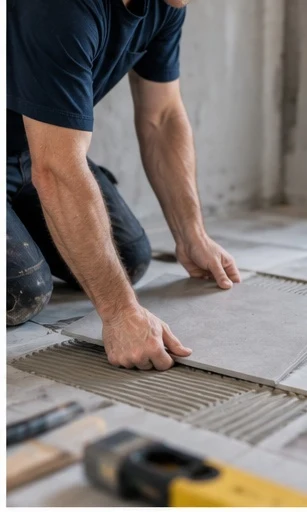
The set-out is the job
Tile choice gets all the attention and set-out does all the work. The set-out is where the tiler decides, before fixing anything, exactly where full tiles will land and where the cuts will go.
Done well, cuts disappear into corners and behind the door, the shower niche is framed by full tiles, the vanity wall reads as symmetrical, and the floor pattern lines up with the wall pattern at the junction. Done badly, there is a 20mm strip beside the doorway that you will notice every single day for the next fifteen years.
This is a conversation to have before work starts, not a surprise to discover afterwards. Ask the tiler where the cuts are going. A good one will already know.
Falls, and the bucket test
Bathroom floors are not flat. They are built with a gradient so water runs to the waste, and getting that gradient right — consistently, across the whole wet area, without creating a lip at the shower entry — is a genuine skill.
The test is refreshingly simple, and you can do it yourself before final payment: tip a bucket of water across the floor and watch where it goes. If it all reaches the waste, the fall is right. If a puddle sits anywhere and stays there, it is not. Ponding is the most common finished-work complaint in a bathroom, and it is far easier to have corrected before the job closes out than after.
Niches, and where they should go
A tiled niche is the highest-value small detail in a modern bathroom — it removes the corner caddy and gives the shower somewhere to put things. Two things decide whether it looks deliberate or improvised.
Position. A niche should sit between studs, at a height that suits the people using it, and it should be centred within the tile set-out rather than wherever the framing happened to allow. That means it is planned at rough-in, several weeks before tiling.
Waterproofing. A niche is a hole in a wet wall, so the membrane detail around it matters more than the tiling does. It should be formed, waterproofed and drained so water cannot sit in the base — a niche with a flat bottom that holds water is a slow leak with a shelf on it.
Tile choice, practically
Beyond looks, three things matter in a bathroom.
Slip resistance on the floor, particularly in a shower and particularly in a household with older or younger occupants. Rated tiles exist for exactly this reason.
Format versus room size. Larger tiles suit larger spans, but the set-out constraint above is real. In a compact bathroom of the kind common in Chatswood and Crows Nest units, a medium format often sits better than a very large one.
Finish and maintenance. Matt and textured tiles hide water marks and are more forgiving underfoot; polished tiles look sharper and show everything. Textured surfaces need slightly more effort to clean. There is no universally correct answer, but there is a wrong one for a household that does not want to squeegee a wall.
Grout, sealing and living with it
Grout is the maintenance surface in a bathroom. Cement-based grout is standard, cost-effective, and porous enough that it will stain over time in a shower. Epoxy grout resists staining far better, costs more and is harder to work with, which is why it is more often specified on floors and in showers than across an entire room.
Sealing is worth asking about explicitly. Sealers reduce absorption in grout and in porous natural stone. They do not make anything waterproof, and they are not a substitute for the membrane underneath. They also wear, so a sealed floor is a maintenance item rather than a permanent state.
The practical advice is unglamorous: squeegee the shower walls, ventilate the room properly, and expect to re-seal at intervals rather than never.
Where tiling sits in the program
Tiling follows waterproofing and cure, and precedes fit-off. It is typically the longest single trade stage of a full renovation, and it is where the room finally starts to look like the drawing.
Tile ordering deserves a mention: lead times on some ranges run to weeks, and running short mid-job risks a dye-lot mismatch. Order with a sensible overage and confirm availability before the strip-out, not after.
The same principles apply in an ensuite, a small bathroom and a laundry. We quote tiling as part of the whole job across Mosman, Lane Cove, Roseville and the rest of the North Shore.
Call 02 4602 1201 or send the details through.
Frequently asked questions
What is a tile set-out and why does it matter?
The set-out is the plan for where full tiles land and where the cuts fall, decided before any tile is fixed. A good set-out centres the work on the features people look at — the shower niche, the vanity wall, the doorway — so cuts end up in low-visibility corners. A bad set-out leaves a 20mm sliver beside the door, and no amount of expensive tile fixes that.
How much fall does a shower floor need?
Enough that water reaches the waste without ponding, and the required gradients are set out in the standards covering wet areas. In practice, the test is simple: after the job, tip a bucket of water on the floor and watch. If it drains away, it is right. If it sits anywhere, it is not, and it should be raised before the account is settled.
Are large-format tiles a good idea in a small bathroom?
Usually, because fewer grout lines read as less clutter. The limit is the set-out — in a very small room a large tile can leave awkward slivers at the perimeter. A tiler should be able to tell you at quoting stage where the cuts will land, and if they cannot, that is worth noticing.
What grout colour should I choose?
Matching the tile makes the surface read as one plane and hides the grid; contrasting emphasises the pattern and, in a small room, tends to make it feel busier. Practically, mid-tones age best — brilliant white shows every mark on a floor and very dark grout can show soap residue.
Should the walls be tiled floor to ceiling?
Full-height tiling looks more considered and removes the paint-to-tile junction that tends to mark and peel over time. It costs more in tiles and labour. A common compromise is full height in the shower and to a lower line elsewhere, which works well if the line is set deliberately rather than landing wherever the tile ran out.