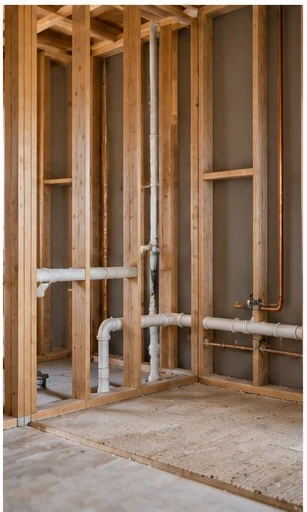
Why this stage decides whether the room lasts
Every other part of a bathroom can be repaired in isolation. A cracked tile is replaced. A leaking tap is rewashered. A vanity that swells at the base is swapped out. Waterproofing is the exception: it sits underneath the screed and the tiles, so a failure cannot be reached without dismantling the finished room above it.
That asymmetry is the whole argument for not compressing this stage. The cost of doing it properly is a few hundred dollars of materials and a few days of program. The cost of doing it badly is the room.
What actually gets waterproofed
The membrane is not applied to the whole room in every case. AS 3740 sets out what has to be protected, and the extent depends on the fixtures and the construction. As a general shape:
- The shower floor and the walls around it, to a height set by the standard and the shower type.
- The whole bathroom floor, in most modern construction, particularly on timber floors and upper storeys.
- Junctions — floor-to-wall, wall-to-wall — with bond breakers so the membrane can move without tearing.
- Penetrations — the floor waste, tap bodies, the shower rail — because every hole in a membrane is a potential path.
The junctions and penetrations are where failures overwhelmingly begin. A membrane rolled beautifully across a flat floor and then rushed at the corner is a membrane that will fail at the corner.
Cure time is not padding
The membrane is applied in coats. Each coat needs to dry. When the last coat is on, the system needs to cure before screed and tiles go over it. In practice this puts several days of unavoidable waiting into the middle of a bathroom program, and more in cold or humid weather.
This is the stage most often squeezed when a job is running late, and it is the worst possible place to find the time. If a builder offers to make up a week, ask specifically where — and if the answer is here, ask again.
How failures show up on the North Shore
The pattern varies with the housing type, which is one reason a contractor who knows the local stock is worth having.
In the 1960s and 1970s walk-up flats through Chatswood, Crows Nest and North Sydney, a failed bathroom membrane frequently announces itself in the unit below rather than in your own — as a ceiling stain. That makes it a strata matter as well as a plumbing one, and it can get expensive and political quickly.
In the suspended-timber-floor houses common through Roseville, Lindfield and Willoughby, water moves into the floor frame instead. The tell is often springiness underfoot, swollen skirting in the adjoining room, or a musty smell in a subfloor. Damage here can run for years before anything visible appears, and by then the framing is usually involved.
What to ask for, in writing
- Confirmation the work is to AS 3740.
- Who is applying the membrane and what licence they hold.
- What is being waterproofed, and to what height.
- Cure time, shown in the program as its own line.
- The documentation on completion — keep it.
What you should get at handover
Waterproofing is the one stage of a bathroom where the paperwork genuinely matters, because the work itself is invisible by the time the job is finished.
Ask for the certificate or compliance documentation from whoever applied the membrane, along with the product used and the date it went on. Keep it with your property records. If you sell, a buyer's inspector may ask for it. If a problem develops inside the workmanship period, that documentation is the difference between a warranty conversation and an argument.
Photographs are the other thing worth having. A handful of pictures of the completed membrane before the screed covers it costs nothing, and it is the only record that will ever exist of what is under your floor. A contractor who is confident in the work will be happy to take them.
Where this sits in the job
Waterproofing follows screeding and precedes tiling, and it is stage four of five in a full renovation. It applies equally in an ensuite, a small bathroom and a laundry, with the extent varying by room.
Call 02 4602 1201 or send the details through.
Frequently asked questions
What standard applies to bathroom waterproofing in Australia?
AS 3740 is the Australian Standard covering waterproofing of domestic wet areas, and it is referenced by the National Construction Code. It sets out where membrane is required, to what height, and how junctions and penetrations are treated. Ask your contractor to confirm in writing that the work is being done to AS 3740.
How long does waterproofing take to cure?
Typically the membrane is applied in coats with drying time between them, and then needs a further cure before tiling can start — commonly a few days in total, and longer in cold or humid weather. This is real waiting time, not padding, and any program that does not allow for it is either optimistic or planning to tile too early.
How do I know if my waterproofing has failed?
The usual signs are damp or bubbling paint on the other side of a shower wall, a musty smell that does not clear, loose or drummy tiles at the base of the shower, swollen skirting in an adjoining room, or a stain on a ceiling below. By the time any of those appear, water has usually been moving for a while.
Can waterproofing be repaired without retiling?
Rarely, and cautiously. The membrane sits under the screed and tiles, so reaching it generally means removing them. There are surface-applied products marketed as repairs, and they can buy time on a minor issue, but they do not replace a failed membrane. Anyone offering to fix a genuine membrane failure without lifting tiles is selling you a delay.
Does the waterproofer need to be separately qualified?
Waterproofing of wet areas is licensed work in NSW and there are specific licence categories covering it. Ask who is doing the membrane, what licence they hold, and ask for the certificate or documentation on completion. Keep that paperwork — it matters if you sell, and it matters more if there is ever a claim.