Before anything is demolished
The work that determines whether a renovation goes smoothly happens before the first tile comes off.
Selections are finalised. Tiles, tapware, vanity, toilet, screen, accessories — chosen, priced and ordered. Lead times on some tile ranges run to several weeks, and a range that is out of stock mid-job risks a dye-lot mismatch. Order with sensible overage.
Approvals are underway. If it is a unit, the owners corporation application goes in. If the property is heritage-listed or in a conservation area — common through Ku-ring-gai — the council conversation starts. These are the longest lead items in most jobs and they run in parallel with everything else.
The program is agreed. Working days, trade sequence, and the cure time shown explicitly.
Stage 1 — Strip-out (1–2 days)
Fittings out, tiles off, screed up, sometimes wall sheeting removed back to frame. A skip arrives, which on the North Shore is its own small logistics problem: a Mosman street with no parking or a third-floor Chatswood walk-up both make this harder than a St Ives driveway.
This is also when the room tells you the truth. Rot, rusted waste pipe, previous unpermitted work and occasionally asbestos sheeting all reveal themselves here. If something is found, work pauses, it gets priced as a variation, and you approve it before it proceeds.
Stage 2 — Rough-in (2–3 days)
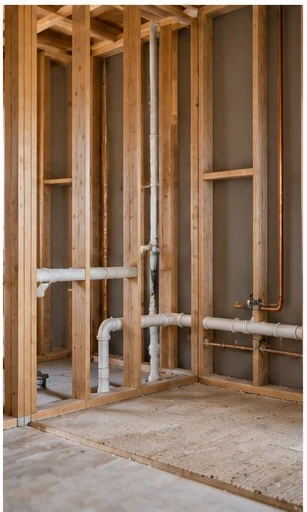
Plumber and electrician set waste, water and cable positions while the walls are open. Any carpentry for new framing, noggins for a wall-hung vanity, or a niche happens now.
Everything decided here is effectively permanent. The position of the shower mixer, the height of the niche, the cable for the mirror light — all locked in at this stage, weeks before you see any of them. This is why selections have to be finished first.
Stage 3 — Screed and fall (1–2 days, then drying)
The floor is built up so water runs to the waste. Then it has to dry.
Stage 4 — Waterproofing (1–2 days, then cure)
The membrane goes on in coats, with drying time between them, and then cures before anything covers it. Together with the screed drying, this is where several days of apparent inactivity sit in the middle of your renovation.
It is not padding, and it is the worst possible place to recover lost time. The waterproofing page explains why in more detail.
Stage 5 — Tiling (3–6 days)
Wall and floor tiling, the longest single trade stage. Set-out is decided before any tile is fixed — where full tiles land, where cuts fall. Then grouting, and grout needs its own drying time before silicone.
Stage 6 — Fit-off (1–2 days)
Vanity, toilet, screen, tapware, mirror, towel rails, silicone. The plumber and electrician return to connect what they roughed in. The room becomes a bathroom in about a day and a half, which is why the whole job feels like it finishes suddenly.
Stage 7 — Handover
Walk the room in good light. Check the fall with a bucket of water. Check the silicone lines, the grout, the door clearances, the drawer alignment and that everything runs hot and cold the way it should.
Get the waterproofing documentation and keep it. Get any warranty paperwork for the fittings.
A realistic calendar
| Stage | Working days |
|---|---|
| Strip-out | 1–2 |
| Rough-in | 2–3 |
| Screed and drying | 1–2 plus drying |
| Waterproofing and cure | 1–2 plus cure |
| Tiling and grouting | 3–6 |
| Fit-off | 1–2 |
| Total | around 15–20 working days |
Fifteen to twenty working days is three to four calendar weeks in a clean run. Add a week for a layout change, and add the approval timeline at the front if it is a unit.
The three things that cause delays
- Selections not finalised. The most common cause, and entirely avoidable.
- Approvals started late. Strata in particular.
- Variations. Unavoidable in an old bathroom, but manageable if the quote sets out how they are priced and approved.
See the 2026 cost bands or the FAQ. Ready to start? Call 02 4602 1201 or send the details through.
Frequently asked questions
How long does a bathroom renovation take?
Three to four working weeks for a standard job that keeps its existing layout, and five or more where walls or drainage move. Working weeks, not calendar weeks — a public holiday or a delayed tile delivery extends the elapsed time without adding any work.
Why does nothing seem to happen for days in the middle?
Because the screed has to dry and the waterproofing membrane has to cure before tiling can start. That is real, necessary waiting built into the chemistry of the materials. A program that shows no gap between waterproofing and tiling is a program that has not allowed for it.
Can I stay in the house during the renovation?
Usually yes, provided there is another toilet and somewhere to shower. If it is the only bathroom, plan alternative arrangements for the full period — this is the most underestimated part of a renovation, and it is worth being realistic about it before the strip-out rather than during.
When do I choose the tiles and fittings?
Before the strip-out, not during. Tile and tapware lead times can run to weeks, and a decision outstanding at rough-in stops the plumber. The single most effective thing a homeowner can do to keep a renovation on program is to finalise selections early.
What is a variation and how should it be handled?
A variation is work outside the original scope, usually because something was found once the room was opened up. It should be documented in writing with a price and approved by you before it proceeds. Verbal variations agreed in a hallway are how disputes start.