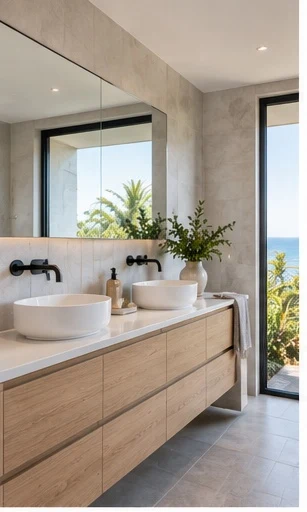
What a full bathroom renovation actually involves
A full renovation is not a refit. It takes the room back to its frame or its slab, and rebuilds it from there. That distinction matters when you are comparing quotes, because a "renovation" that leaves the old screed and the old membrane in place is a much smaller job wearing the same word.
The sequence runs in five stages, and they cannot be reordered:
- Strip-out. Fittings, tiles, screed, sometimes the wall sheeting, out to a skip. On the North Shore this stage is also where access reveals itself — a Mosman terrace with no driveway and a Chatswood walk-up on the third floor both make a skip harder than a Roseville front yard does.
- Rough-in. Plumber and electrician set the new waste, water and cable positions while the walls are open. Whatever is decided here is effectively permanent, which is why layout changes have to be resolved before demolition day, not during.
- Screed and fall. The floor is built up to run water to the waste. Getting the fall right is unglamorous and absolutely load-bearing — a floor that ponds is a floor that will be complained about for the life of the room.
- Waterproofing. The membrane goes on in coats, with cure time between them, and the standard covering domestic wet areas in Australia is AS 3740. This is the stage nobody sees again and the one that decides whether the room lasts.
- Tiling and fit-off. Wall and floor tiles, then the vanity, toilet, screen, tapware, mirror, towel rails and the silicone that everybody inspects at close range.
Where the money goes
Two decisions drive most of the variation in a North Shore bathroom quote, and neither of them is tile choice.
Does the layout move? Leaving the wastes where they are is the difference between a plumber connecting to existing pipework and a plumber cutting a slab. In the 1960s and 1970s walk-ups common through Crows Nest, North Sydney and parts of Chatswood, the floor is a concrete slab and moving a waste is genuinely expensive. In a suspended timber floor — most of the interwar housing through Roseville and Lindfield — it is far more tractable.
What is behind the tiles? A 1970s bathroom that has been leaking quietly into the wall frame for a decade is a different job to one that has not. Nobody can tell which you have until the tiles come off, which is why the variation clause in your quote is worth reading more carefully than the inclusions list.
After those two, the finishes matter: tile format and price per square metre, tapware brand, whether the vanity is off-the-shelf or made, and whether you want a niche, a frameless screen or underfloor heating.
2026 cost bands, North Shore
Indicative planning ranges only — the quote after a measure is what binds:
| Job | Indicative 2026 range |
|---|---|
| Small bathroom, like-for-like | $18,000 – $28,000 |
| Standard main bathroom, full strip and refit | $25,000 – $40,000 |
| Large bathroom or a layout change | $40,000 – $70,000+ |
The cost page breaks these down further and explains what pushes a job from one band to the next.
What a good quote names
Ask for these in writing before you compare anything:
- Tapware and fittings by brand and model.
- The tile allowance per square metre, and who buys them.
- Whether waterproofing cure time is in the program.
- Skip and rubbish removal as a line, not an assumption.
- The variation process — how a discovery behind the wall gets priced and approved.
- The program, in working days, with the trades sequenced.
Licensing, plainly
In NSW, residential building work above a set value must be carried out by an appropriately licensed contractor, and work above a higher threshold generally requires home building compensation cover. Plumbing and electrical work must be done by separately licensed trades regardless of job size. NSW Fair Trading publishes the current thresholds and a public licence register, and both are worth checking yourself.
This is a referral site. The contractor who quotes your job holds the licence and the insurance, not us — ask to see the certificates before work starts.
Call 02 4602 1201 or send the room details through and we will arrange a measure.
Frequently asked questions
What is included in a full bathroom renovation?
Demolition and rubbish removal, plumbing and electrical rough-in, any carpentry needed for new wall or floor framing, screeding and falls to the waste, waterproofing to AS 3740, wall and floor tiling, then fit-off of the vanity, toilet, shower, tapware, screen, mirror and accessories. A full renovation takes the room back to the frame or the slab — anything less is a partial refit and should be quoted as one.
How much does a full bathroom renovation cost on the North Shore?
As a 2026 planning guide, a standard main bathroom of around 5–7 square metres taken back to frame and refitted generally lands between $25,000 and $40,000. Keeping the existing layout holds you toward the bottom of that band; moving the toilet or shower pushes you toward the top or past it. The written quote after a measure is the number that counts.
Can I keep the existing layout to save money?
Usually, and it is the single most effective saving available. Leaving the toilet, shower and vanity wastes where they are avoids re-routing drainage, which on a slab floor means cutting concrete — expensive in itself and disruptive on top. A good designer can change how a bathroom feels substantially without moving a single waste.
What happens if something is found behind the wall?
On a bathroom built before about 1990 it is common to find water damage, rusted cast-iron waste pipe, previous unpermitted work, or asbestos-containing wall sheeting behind the tiles. The quote should say in advance how variations of that kind are priced and approved. Asbestos in particular stops the job until it is assessed, and removal is carried out by a separately licensed asbestos removalist.
How long does a full renovation take?
Three to four working weeks for a standard job that keeps its layout, and five or more if walls or wastes move. Roughly a quarter of the elapsed time is waiting rather than working — the screed has to dry and the waterproofing membrane has to cure before tiling can begin.